Does a Minimalist Workout Routine Actually Work Long-Term, or Just Short-Term?
Quick Answer: Minimalist routines (2-3 compound exercises, 20-30 minutes, 2-4 times weekly) can maintain and even build meaningful strength and fitness long-term, provided progressive overload is applied consistently. The main long-term risk isn’t the approach’s effectiveness — it’s plateau management as the easy initial gains taper off.
A minimalist routine is easy to start and easy to love in month one. The real question anyone considering this approach should ask isn’t whether it works initially — it clearly can — but whether it holds up at month twelve and beyond.

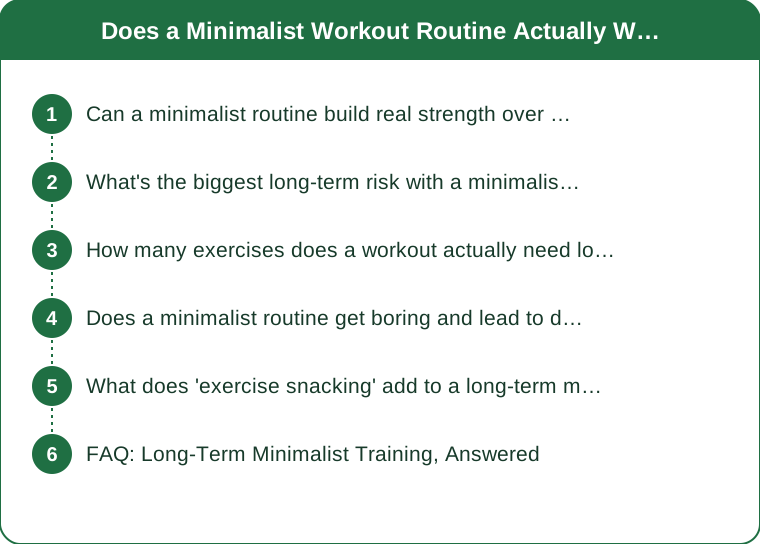
Can a minimalist routine build real strength over the long term?
Yes, provided progressive overload is genuinely applied — increasing weight, reps, or difficulty over time rather than repeating the same exact session indefinitely. Research on minimal effective dose training consistently shows that a small number of well-chosen compound movements, progressively loaded, can produce strength gains comparable to more complex programs for general fitness goals, particularly for those not chasing elite performance.
What’s the biggest long-term risk with a minimalist approach?
Plateau, not lack of initial results. The first several months of any new training stimulus produce relatively fast gains regardless of program complexity — the real test of a minimalist routine is whether it has a built-in mechanism for continued progression once those beginner gains taper off around month 4-6, which is where many minimalist routines without a clear progression plan start to stagnate.
How many exercises does a workout actually need long-term?
For general fitness maintenance, a well-chosen 3-5 exercise routine covering push, pull, hinge, squat, and core patterns covers the major movement categories needed for balanced long-term strength — additional exercise variety adds engagement and addresses minor imbalances, but isn’t strictly required for maintaining broad functional strength over years.

Does a minimalist routine get boring and lead to drop-off over time?
This varies by individual, and it’s a real, documented adherence risk — routine monotony is a commonly cited reason for program abandonment in exercise adherence research generally, not specific to minimalist programs. The mitigating factor most often cited: rotating which specific exercises fill each movement pattern slot every 8-12 weeks, keeping the minimalist structure while varying the specific movements enough to sustain interest.
What does ‘exercise snacking’ add to a long-term minimalist approach?
Short bursts of movement scattered through the day (a few minutes of bodyweight exercise, several times daily) rather than one consolidated session is a documented alternative approach with its own long-term adherence advantages — some people sustain a movement habit for years using this scattered format when a single structured session repeatedly fails to stick. It’s a variant worth considering specifically for long-term sustainability, not just as a beginner’s stepping stone.
FAQ: Long-Term Minimalist Training, Answered
Do minimalist routines eventually need to add volume to keep progressing?
Often yes, past an initial period — this can mean adding reps, sets, or load rather than adding more exercises, keeping the routine’s structural simplicity while still providing continued progressive stimulus.
Is a minimalist routine enough for long-term bone density and muscle maintenance?
Generally yes, if it includes adequate resistance loading on major movement patterns 2+ times weekly — the research on minimal effective dose training supports this for general population health goals.
Should minimalist training be combined with anything else long-term?
Many long-term practitioners add a cardio component (even just consistent walking) alongside a minimalist strength routine, since the strength routine alone doesn’t specifically address cardiovascular fitness goals.
TL;DR:
- Minimalist routines can build real long-term strength if progressive overload is genuinely applied
- The biggest risk is plateau around month 4-6, not the initial approach itself
- 3-5 exercises covering major movement patterns cover long-term general fitness needs
- Rotating specific exercises every 8-12 weeks helps sustain long-term adherence
The approach holds up long-term — but only if it has a built-in plan for progression, not just repetition of the same starting routine indefinitely.
Keep Reading
This article is for general informational and styling purposes only. Fit, sizing, and product availability may vary.