Why a Minimalist Routine Gets Harder to Keep Once It Starts Working
Quick Answer: Success creates the conditions for abandonment. As you get fitter the same session feels easier relative to your capacity, recovery improves so you have spare energy, and progress feels slower because early gains are always fastest. Together these produce the conviction that the routine has stopped working, when what has actually changed is you. The correct response is to add load, not exercises, and to raise volume by one set at a time rather than redesigning the programme.
Weeks one to six were great. You were consistent, you were sore, things moved.
Week ten you are doing the same four exercises, they take twenty minutes, you are barely tired afterwards, and you have started reading about programmes with nine exercises.
That is the moment most minimalist routines die, and it is worth understanding what is actually happening.

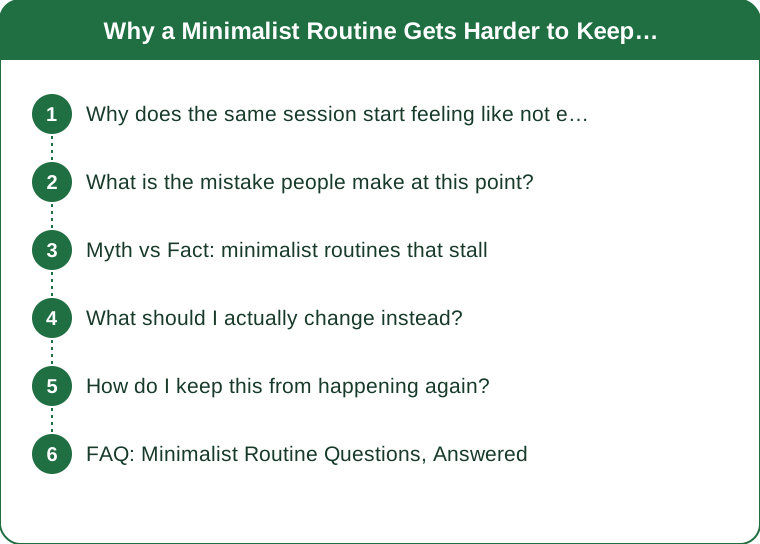
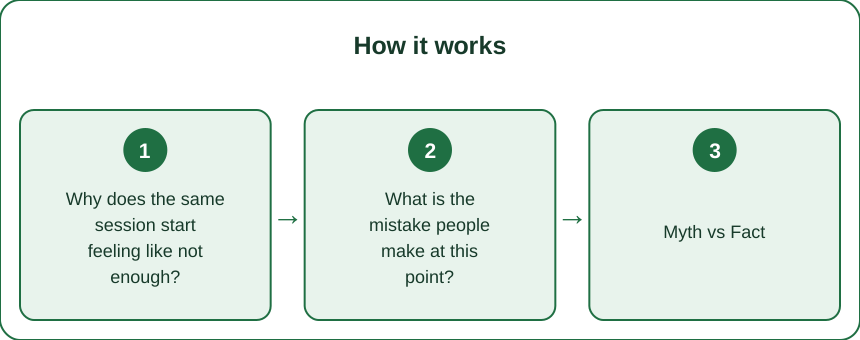
Why does the same session start feeling like not enough?
Three things change simultaneously, and all of them are signs of progress being misread as signs of failure.
Your work capacity rose. The same three sets that were genuinely demanding in week one now sit comfortably inside what you can handle. The session did not shrink. Your capacity grew around it.
Recovery improved. Trained people recover faster from the same stimulus. The soreness that used to confirm the session happened has largely disappeared, and most people use soreness as their primary feedback signal even though it correlates poorly with adaptation.
The rate of visible progress slowed. Early gains are dominated by neural adaptation, which is fast. Once that is largely banked, progress becomes structural and structural progress is slow. A programme delivering excellently in month four will feel less impressive than a mediocre programme in month one, purely because of where the curve is.
So you have more capacity, less feedback, and slower visible change, all at once. The conclusion that something is wrong is completely understandable and completely incorrect.
What is the mistake people make at this point?
Adding exercises, which is the one change that most reliably ends the routine.
The logic seems sound. The session feels easy, so make it bigger. But adding exercises does four things, only one of which was intended.
Session length grows, which was the exact constraint the minimalist routine was designed around. A 20-minute session that becomes 45 minutes is no longer a session that fits into a busy Tuesday.
Adherence falls, and adherence is the dominant variable in every long-term training outcome. A perfect programme done 50 percent of the time loses to a modest programme done 90 percent of the time, and it is not close.
Recovery demand rises across more movement patterns, which means more accumulated fatigue for the same central lifts.
Progression gets harder to track, because nine exercises are harder to add weight to systematically than four are.
Meanwhile the actual problem, insufficient load on the exercises you are already doing, remains unaddressed. The session felt easy because the weight was too light. Adding a fifth exercise does not fix a light weight.
Myth vs Fact: minimalist routines that stall
Myth: If a routine stops producing soreness, it has stopped working. Fact: Soreness reflects novelty and eccentric damage, not adaptation. Trained people get less sore from effective training. It is one of the least useful progress signals available.
Myth: More exercises means more results. Fact: Total hard sets per muscle group per week drives most hypertrophy outcomes, and those sets can come from few exercises or many. Variety has some benefits but exercise count itself is not the variable.
Myth: You need to change the programme every six to eight weeks. Fact: This is one of the most persistent gym myths. Sticking with the same movements long enough to get genuinely strong at them is more productive than rotating, and the ability to add load week to week is the actual driver.
Myth: The session should leave you exhausted. Fact: Effective sessions frequently do not. Finishing with something in reserve is compatible with excellent progress and it is far more sustainable.
Myth: Minimalist means low effort. Fact: It means low volume at high effort. A minimalist routine with easy sets is not a minimalist routine, it is an insufficient one, and that distinction is exactly what goes wrong at week ten.

What should I actually change instead?
In order, and only one at a time.
- Add load first. If you can complete every set comfortably at the target rep count, the weight is too light. Add the smallest increment available and keep the structure identical. This resolves the majority of week-ten complaints on its own.
- Take sets closer to failure. Aim to finish most working sets with roughly one to three reps left in reserve. Many people doing minimalist routines are stopping at five or six reps in reserve without realising, which is where the not enough feeling genuinely comes from.
- Add one set, not one exercise. Going from three sets to four on your main lifts adds meaningful volume for about three extra minutes.
- Then, and only then, consider a fifth exercise, and add it to address a specific gap rather than a general feeling.
- Slow the tempo on the lowering phase if load increases are not available, as with bodyweight work. Three seconds down changes the stimulus substantially at the same weight.
How do I know if it is working without soreness?
Use numbers. Weight lifted, reps completed, or time held. If those are moving month over month, it is working, regardless of how you feel afterwards.
How do I keep this from happening again?
Build the answer into the routine before you need it.
Write down the progression rule at the start. For example: when you hit the top of the rep range on all sets, add weight next session. A rule removes the judgement call at exactly the moment your judgement is being distorted by the plateau feeling.
Track sessions, not sensations. A note on your phone with weight and reps takes ten seconds and gives you the evidence that feelings will contradict.
Schedule a deload rather than a redesign. Every eight to twelve weeks, cut volume roughly in half for a week. The restless feeling is often accumulated fatigue rather than boredom, and a deload usually resolves it while a redesign wastes the previous ten weeks.
Give any change eight weeks before evaluating it. Almost nothing meaningful is visible in four.
And remember why the routine was minimal in the first place. It was built to survive a bad week, a work trip, a sick child, a late meeting. That property is the whole value, and it is the first thing you lose when you make the session bigger. A routine that runs for three years at 20 minutes beats a routine that runs for five weeks at 50 minutes by a margin that is genuinely hard to overstate.
This is general information, not medical advice.
FAQ: Minimalist Routine Questions, Answered
Is it normal to feel bored around month three?
Extremely. Boredom and plateau feel identical from the inside and have different solutions. If your numbers are still moving, it is boredom, and swapping one exercise for a similar one usually fixes it without expanding the session.
Should I add cardio at this point?
If the goal includes cardiovascular fitness, yes, but keep it separate from the strength session so the constraint that makes the routine work stays intact.
How long can a four-exercise routine keep producing progress?
For most non-competitive lifters, years, provided load keeps increasing and sets are taken close enough to failure. The limit is usually motivation rather than physiology.
What if I genuinely have more time now?
Then adding is reasonable. Add frequency before you add exercises, since a third short session usually beats making two sessions longer.
TL;DR:
- A minimalist routine feels insufficient at the exact point it is working, because capacity rose, recovery improved, and early fast gains ended.
- Soreness is a poor progress signal and its disappearance is not evidence of failure.
- Fix the load first: heavier weight, closer to failure, then one extra set. Adding exercises is the change most likely to end the routine.
- Write the progression rule down in advance, track numbers rather than feelings, and deload instead of redesigning.
The minimal session was never the point in itself. Its value is that it survives the weeks when nothing else would, and that value evaporates the moment you make it big enough to skip.
This is general information, not medical advice.
Keep Reading
This article is for general informational and styling purposes only. Fit, sizing, and product availability may vary.