The One Pair of Dumbbells Routine
Quick Answer: One pair of dumbbells covers every movement pattern if you progress with reps, tempo, range, and unilateral variations rather than with weight. Four exercises — goblet squat, Romanian deadlift, floor press, and single-arm row — cover squat, hinge, push and pull. Run them twice a week for three sets each, progress by adding reps until you reach 15, then slow the tempo and start again. This works for considerably longer than most people expect.
Everyone tells you that you need adjustable dumbbells, a bench, a rack, and eventually a barbell.
You have one pair of 12kg dumbbells and a living room floor, and the honest answer is that this is enough for a surprisingly long time — as long as you stop trying to progress the way a gym program does.
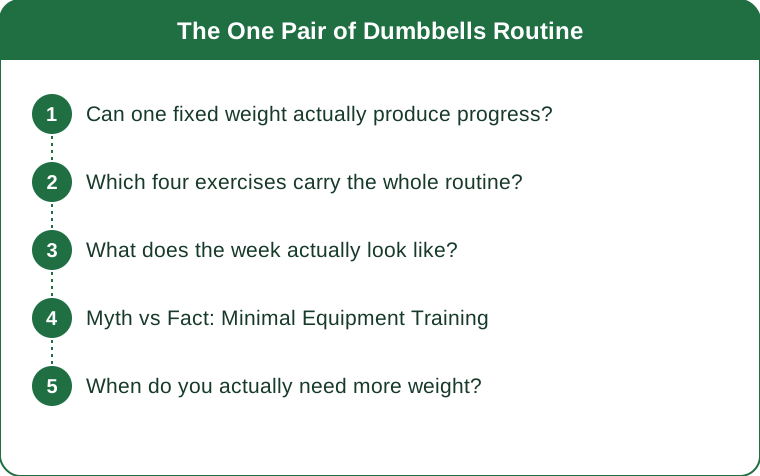
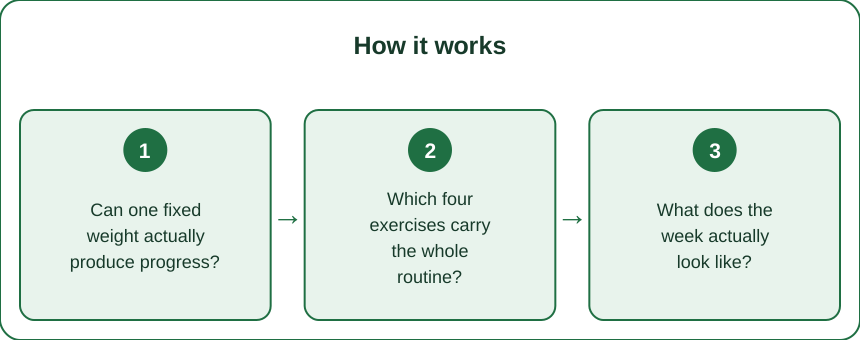
Can one fixed weight actually produce progress?
Yes, because load is only one of five ways to make an exercise harder, and it is not the most important one for a beginner or an intermediate.
The five levers:
1. Repetitions. The obvious one. Eight becomes twelve becomes fifteen.
2. Sets. Three becomes four becomes five. Total volume drives a lot of adaptation.
3. Tempo. A three-second lowering phase makes a squat dramatically harder than a one-second one, with the same weight. Time under tension is a genuine driver of hypertrophy and it is completely free.
4. Range of motion. A deficit squat with your heels on a book, or a press from a deeper starting position, increases difficulty substantially.
5. Unilateral loading. This is the big one. A single-leg or single-arm version of a movement roughly doubles the effective load on the working limb. A pair of 12kg dumbbells becomes an effective 24kg the moment you go to one leg.
Combine them and one pair of dumbbells covers an enormous range. Someone using all five levers well can train productively with a fixed weight for a year or more.
Which four exercises carry the whole routine?
One per fundamental pattern, chosen because each has a clear progression path with fixed weights.
Goblet squat — the squat pattern. Hold one dumbbell at your chest. Progress: reps to 15, then a 3-second lowering phase, then heels elevated, then to a single-leg split squat holding both dumbbells.
Romanian deadlift — the hinge pattern. Both dumbbells, soft knees, push the hips back, feel it in the hamstrings. Progress: reps, then tempo, then single-leg RDL, which is both a strength and a balance exercise and considerably harder than it looks.
Floor press — the push pattern. Lie on the floor, press both dumbbells up. The floor limits range, which is actually useful for shoulders. Progress: reps, tempo, then single-arm, which adds a significant anti-rotation core demand.
Single-arm row — the pull pattern. One hand braced on a chair, row one dumbbell. Already unilateral, so progress with reps, tempo, and a pause at the top.
Optional fifth: the suitcase carry. Walk holding one dumbbell at your side. Grip, core, and posture in one movement that requires no technique to learn.
Those four cover squat, hinge, push, and pull, which is the complete set of fundamental patterns. Everything else is a variation on them.
What does the week actually look like?
Two sessions, same four exercises, about 30 minutes each.
Session structure:
- Goblet squat: 3 sets
- Romanian deadlift: 3 sets
- Floor press: 3 sets
- Single-arm row: 3 sets each side
- Suitcase carry: 2 sets of 30 seconds each side, if time allows
Rest 60 to 90 seconds between sets. Total time is 25 to 35 minutes.
Two sessions a week is the minimum effective dose and it genuinely works. Three is better if you have the time, and the difference between two and three is smaller than the difference between zero and two.
The progression rule: start where you can do 8 to 10 solid reps. Each session, add a rep to one set. When all sets reach 15, do not add weight — switch to the harder variation and start again at 8.
That single instruction is what makes the fixed weight work. Most people, given one pair of dumbbells, reach 15 reps, get bored, and conclude they need heavier ones. The progression was available; it just was not more weight.
Myth vs Fact: Minimal Equipment Training
Myth: You need progressive overload with weight or you will not build muscle. Fact: You need progressive overload, and weight is one of several ways to deliver it. Volume, tempo, and range all drive adaptation. The research on training close to failure with lighter loads shows comparable hypertrophy to heavier loads when effort is matched.
Myth: Bodyweight and light dumbbells are for maintenance, not building. Fact: They are for building until you run out of levers, which takes most people well over a year. The limitation arrives eventually — it is just much later than the equipment industry suggests.
Myth: A minimalist routine needs less warm-up because it is shorter. Fact: It needs the same or more, because the first working set arrives sooner. Five minutes of movement before you start, always.
Myth: Four exercises is too few to be a real program. Fact: Four exercises covering all four movement patterns, done consistently for six months, outperforms a twelve-exercise program done for three weeks. Adherence is the variable that actually decides outcomes, and short routines win on adherence by a wide margin.
Myth: You will plateau within weeks. Fact: You will plateau when you stop using the levers, which is a programming problem rather than an equipment problem.
When do you actually need more weight?
When you are at 15 reps on the hardest unilateral variation with a slow tempo, and it is still comfortable.
That is a genuinely high bar. For most people it means single-leg squats and single-arm presses for 15 slow, controlled reps — a level of strength that takes considerable time to reach from a standing start.
Signs you are not there yet:
- You have not tried the unilateral variations
- Your tempo is fast on the lowering phase
- You are doing 3 sets rather than 4 or 5
- You have skipped sessions in the last month
Any of these means the levers are still available, and buying equipment is a way of avoiding using them.
When you genuinely are there, the most efficient purchase is one heavier pair rather than an adjustable set — a second, heavier pair covers squats and hinges while the lighter pair handles presses and rows, and the combination stretches much further than either alone.
And a note on hardest-first ordering: if you only have time for two exercises on a given day, do the squat and the row. Lower body and pulling are the patterns most neglected in home training, and the two that contribute most to how you actually move.
TL;DR:
- Load is one of five progression levers — reps, sets, tempo, range, and unilateral variation cover the rest, and unilateral work roughly doubles effective load.
- Four exercises cover every pattern: goblet squat, Romanian deadlift, floor press, single-arm row.
- Two 30-minute sessions a week, three sets each; when you hit 15 reps, switch to the harder variation rather than adding weight.
- You need heavier weights only when the hardest unilateral variation at slow tempo is comfortable for 15 reps.
Pick up your dumbbells and try a single-leg Romanian deadlift for eight reps. If that is hard — and it will be — you have found roughly a year of progression sitting in equipment you already own.
Keep Reading
This article is for general informational and styling purposes only. Fit, sizing, and product availability may vary.