How Do You Track Progress When the Whole Routine Is Four Exercises?
Quick Answer: Track four things beyond weight: total reps at a given load, reps in reserve on the last set, time to complete the session, and range or control quality. On a four-exercise routine you will add reps and improve control for weeks between any weight increase, and a log that only records weight makes a progressing program look stalled - which is the most common reason people abandon minimalist training that was working.
You have squatted the same 20kg for a month, so the routine has stopped working.
Except last month it was three sets of six with a hard final set, and this month it is three sets of ten with two left in the tank. That is a 67 percent increase in work, and your log did not have a column for it.

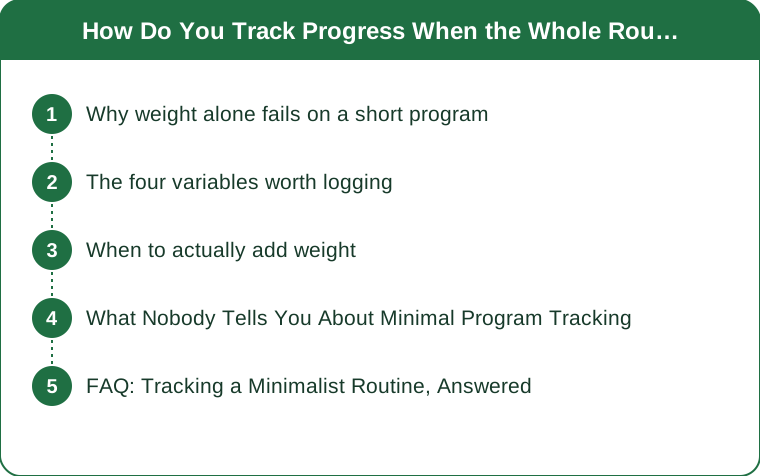
Why weight alone fails on a short program
Fewer exercises means fewer opportunities to load. On a ten-exercise program something is always ready to go up. On a four-exercise program all four may sit at the same weight for weeks while genuinely getting easier.
Increments are too large relative to the movement. Adding 2.5kg to a 20kg squat is a 12.5 percent jump, and there is often no smaller plate available at home. Meanwhile you can add one rep per set, which is a far more appropriate increment.
Weight also hides the quality changes that dominate the first several months of any program - depth, control, bracing, tempo. Those improve continuously and are invisible in a weight column.
And on a minimalist routine, quality is a larger share of the return, because each exercise carries more of the total stimulus. A better-executed squat is worth more when the squat is a quarter of your entire program.
This is why minimalist plans get abandoned while working. The person is progressing on three of four available variables and tracking only the fourth.
The four variables worth logging
Total reps at a load. Multiply sets by reps and record the number. Three sets of six is 18; three sets of ten is 30. That single number captures most of what changes between weight increases and is the most useful column in the whole log.
Reps in reserve on the final set. How many more you could have done - your best honest estimate. Going from zero in reserve to three at the same weight and reps is a large adaptation with no other trace. Aim to keep working sets at roughly one to three in reserve.
Session duration. Same work in less time is improved work capacity, which is a genuine fitness gain. Note the start and end time; it takes four seconds and reveals a trend most people never see.
Range and control, as a simple note. Two words is enough - depth better, no wobble, controlled descent. Not measurable, entirely trackable, and on a short program it is often where the real progress lives.
Together those four take about thirty seconds to record and turn a flat weight column into a picture that actually reflects what is happening.

When to actually add weight
Use the double progression rule. Pick a rep range - say 8 to 12. Add reps within the range each session until you hit the top of it for all sets. Then add weight and drop back to the bottom of the range. This gives a minimalist program a clear rule for both variables.
Wait until you have two in reserve at the top of the range. Adding weight the moment you hit the top rep count usually means the next session collapses, and the psychological cost of going backward is higher on a short program.
Add the smallest increment available, and if you train at home with limited plates, add a rep or a set instead. Fractional plates are inexpensive and solve this permanently for anyone training with dumbbells or a barbell.
Expect long plateaus at a given weight, and treat them as normal rather than as failure. On four exercises, three to five weeks at one load while reps climb is an ordinary and productive block.
And do not add exercises to break a stall. That is the single most common way a minimalist program stops being one, and the stall is almost never caused by exercise selection.
What Nobody Tells You About Minimal Program Tracking
A stalled log usually means the wrong variable is being tracked, not a stalled body. This is worth checking before any program change, and it resolves the majority of perceived plateaus on short routines.
Two-week comparisons are noise. Sleep, stress, food, heat, and time of day move a session by 10 percent easily. Compare month to month, and specifically compare like sessions - the Monday session to the Monday session.
Photos and measurements move on a much slower timescale than the log, so taking them monthly rather than weekly avoids a great deal of pointless discouragement.
A benchmark session every eight to twelve weeks is worth more than daily tracking. Pick a fixed test - a rep max at a set weight, a timed carry, a set of push-ups to near failure - and repeat it identically. That is your real progress measure.
Bodyweight is the least informative number available on a strength program, and on a four-exercise routine it moves for reasons almost entirely unrelated to whether the training is working.
And the log itself does work. Recording sessions improves adherence independently of what you record, which on a minimalist program is most of the battle.
FAQ: Tracking a Minimalist Routine, Answered
How often should the weight go up?
On a short program, often every three to five weeks per lift after the first couple of months. That is normal, not slow.
What if total reps stop climbing too?
Then you have a genuine plateau. Check sleep and food first, then deload for a week at about 60 percent of the volume before changing anything about the program.
Do I need an app?
No. A notebook with five columns - date, exercise, weight, total reps, reps in reserve - covers everything described here.
Is reps in reserve reliable if I am new?
Less so at first; accuracy improves within a couple of months. Even an imprecise estimate tracked consistently reveals a trend.
How do I track bodyweight exercises?
Same way, using total reps and reps in reserve, plus leverage changes - elevating the feet, slowing the tempo, or pausing at the bottom are all load increases.
Should I add an exercise if progress stops?
Almost never. Check the tracking first, then deload. Adding exercises turns a minimalist routine into a normal one and rarely addresses the actual cause.
TL;DR:
- On a four-exercise routine, weight on the bar is the slowest-moving and least informative variable.
- Track total reps at a load, reps in reserve on the last set, session duration, and a two-word note on control.
- Use double progression: add reps within a range, then add weight and drop back to the bottom of it.
- Three to five weeks at one load while reps climb is a productive block, not a plateau.
- Benchmark with an identical test session every eight to twelve weeks; ignore two-week comparisons entirely.
Most minimalist programs that get abandoned were progressing on three variables and being judged on the fourth.
Keep Reading
This article is for general informational and styling purposes only. Fit, sizing, and product availability may vary.