How Few Exercises Do You Actually Need?
Quick Answer: Five movement patterns cover the whole body: a squat, a hinge, an upper-body push, an upper-body pull, and a loaded carry. Pick one exercise per pattern and you have a complete programme. Three sets of each, twice a week, is roughly 30 minutes and clears the effective volume threshold for most people. Adding exercises beyond this produces diminishing returns quickly - and the returns come from taking sets closer to failure, not from adding variety.
The reason more exercises feel necessary is that most programmes are written to look comprehensive rather than to be efficient.
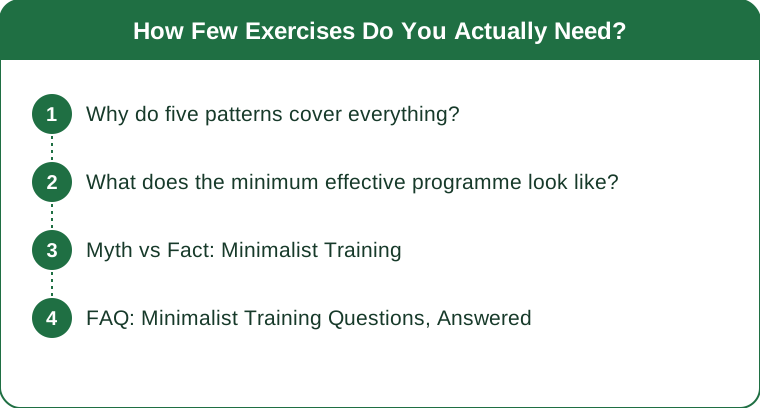
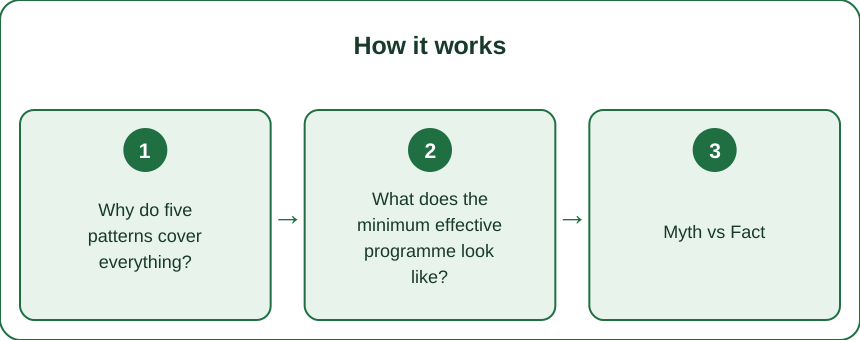
Why do five patterns cover everything?
Because muscles do not work in isolation, and compound movements recruit far more than their name suggests.
A squat pattern trains quadriceps, glutes, adductors, and the entire trunk as a stabiliser. It is not a quad exercise with extras - it is a whole lower-body and trunk exercise.
A hinge - deadlift, Romanian deadlift, hip thrust - trains the posterior chain: hamstrings, glutes, spinal erectors, and grip. The squat and the hinge together cover the lower body comprehensively, which is why leg day rarely needs six exercises.
A push - bench press, push-up, overhead press - covers chest, shoulders, and triceps. A horizontal push and a vertical push differ, but either alone covers the pattern adequately for general fitness.
A pull - row or pull-up - covers lats, mid-back, rear delts, and biceps. The pull is the most commonly under-trained pattern in self-designed programmes, which is worth knowing.
A loaded carry trains grip, trunk stability, and gait under load simultaneously, and it transfers directly to daily life. It is the most underrated exercise in general fitness and it needs no technique instruction.
What is genuinely not covered: direct arm work, direct calf work, and neck. None of these are necessary for health or general strength - they are physique or sport-specific additions, which is a perfectly valid reason to add them, just not a health one.
What does the minimum effective programme look like?
Two sessions a week, five exercises each, roughly 30 minutes.
Session A and Session B are identical. Repetition is a feature - it makes progression trivially easy to track and it removes all decision-making.
The programme: Goblet squat or leg press, 3 sets of 8 to 12. Romanian deadlift or hip thrust, 3 sets of 8 to 12. Push-up or bench press, 3 sets of 8 to 12. Dumbbell row or lat pulldown, 3 sets of 8 to 12. Farmer carry, 3 rounds of 40 metres.
Total: 15 working sets, about 30 minutes with 90-second rests, plus a warm-up.
That produces roughly 6 hard sets per muscle group per week, which sits within the range associated with meaningful adaptation for most people, especially those not already highly trained.
Progress by adding weight when you hit the top of the rep range on all sets. This is the entire progression model - no periodisation required at this level.
Where it stops being enough: if you want maximum muscle size, if you compete in a specific sport, or once you are genuinely well trained. For everyone else, the honest constraint is not that this programme is too small - it is that people do not do it consistently.

Myth vs Fact: Minimalist Training
Myth: You need to hit muscles from multiple angles. Fact: Angle variation has some value for complete development, but it is a refinement, not a requirement. A single well-chosen compound movement per pattern, taken close to failure, produces most of the available adaptation.
Myth: More exercises mean better results. Fact: Beyond a moderate weekly volume, returns diminish sharply and recovery cost rises faster than adaptation. More exercises frequently means more sets performed further from failure, which is worse rather than better.
Myth: You need to change your programme regularly to avoid plateaus. Fact: Plateaus come from lack of progressive overload, not from familiarity. Changing exercises frequently makes progression harder to track and resets the skill component each time. Change the load, not the list.
Myth: Isolation exercises are necessary for balanced development. Fact: For health, strength, and function, no. For maximising the size of specific muscles, yes - which is a legitimate but different goal, and worth being honest with yourself about.
Myth: A 30-minute programme cannot be enough. Fact: Fifteen hard sets, twice a week, is a genuinely effective dose for most non-athletes. The limiting factor in almost every case is consistency over years, not session length - and a 30-minute session is far easier to sustain than a 75-minute one.
FAQ: Minimalist Training Questions, Answered
Is five exercises really enough?
For general strength, health, and function, yes. Five compound patterns cover the whole body, and three sets of each twice weekly clears the volume threshold associated with meaningful adaptation.
What if I want bigger arms or glutes specifically?
Then add direct work for those - that is a physique goal rather than a health one, and it is a completely reasonable reason to expand the programme. Add two or three sets, not a whole extra session.
How do I progress without adding exercises?
Add weight when you reach the top of the rep range on all sets. When weight stalls, add a set, or slow the lowering phase to three seconds. Variety is not a progression tool.
Do I need to change the programme to avoid a plateau?
No. Plateaus come from a lack of progressive overload. Repeating the same five exercises makes progression easier to see, not harder.
Can I do this at home?
Yes, with a pair of adjustable dumbbells or a few resistance bands. Goblet squats, Romanian deadlifts, push-ups, dumbbell rows, and farmer carries all work in a small space.
How long until I see results?
Strength changes are usually noticeable within four to six weeks, largely from neural adaptation at first. Visible body composition changes take longer and depend on nutrition as much as training.
TL;DR:
- Five patterns cover the whole body: squat, hinge, push, pull, carry - one exercise each is a complete programme.
- Three sets of each, twice a week (~30 minutes) gives roughly six hard sets per muscle group weekly, which is a meaningful dose.
- Progress by load, not by variety - changing exercises frequently makes progression harder to track.
- Loaded carries are the most underrated exercise for general fitness; pulls are the most under-trained.
- Direct arm, calf, and isolation work is a physique addition, not a health requirement.
The reason this works is not that minimalism is magic. It is that a 30-minute programme you run for three years beats a 75-minute one you run for five weeks - and the five-pattern version is the smallest thing that still covers everything.
This is general information, not medical advice.
Keep Reading
This article is for general informational and styling purposes only. Fit, sizing, and product availability may vary.