How Short Can a Strength Session Be and Still Count?
Quick Answer: A strength session counts at around 15 minutes if it is built honestly: two or three compound movements, two hard working sets each, taken close to failure. Research on low-volume training shows meaningful strength and muscle gains from single hard sets, and even one weekly session produces measurable progress in beginners — the floor for “worth doing” is far lower than gym culture admits. What shrinks is not the benefit per set but the margin for wasted sets: a short session has no room for warm-up theater, phone scrolling, or easy work that ends three reps early.
The all-or-nothing instinct — no full hour, so nothing today — is the most expensive habit in fitness. The evidence runs the other way: the first sets of hard work carry a disproportionate share of the payoff, and the difference between zero and fifteen honest minutes is the largest single jump on the entire dose-response curve.

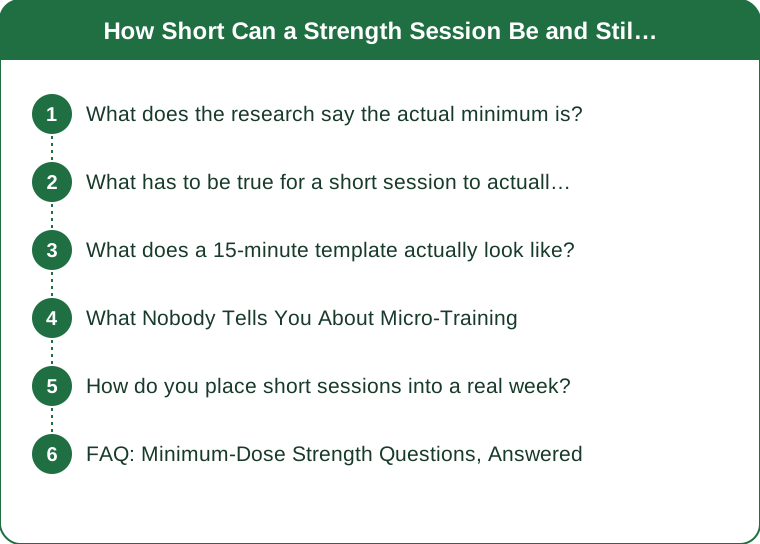
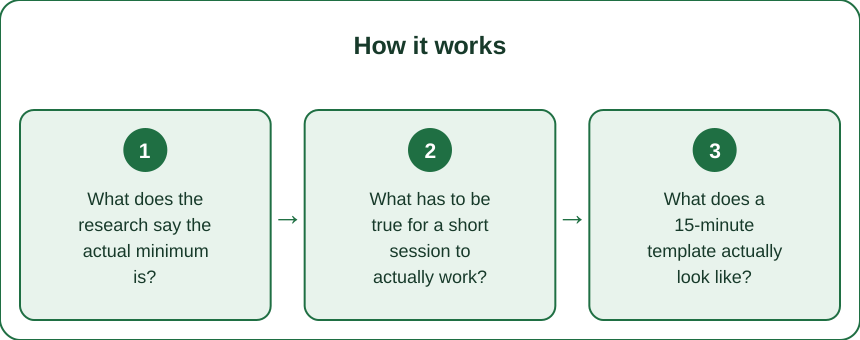
What does the research say the actual minimum is?
Lower than almost anyone trains.
On strength: multiple trials and meta-analyses find that single sets taken near failure produce most of the strength gains of three-set programs in untrained and moderately trained people — more sets help, but with sharply diminishing returns per set. Two to three hard sets per movement captures the majority of what five would deliver.
On frequency: even one session a week builds measurable strength in beginners, and two to three weekly short sessions match or beat one long one at equal total volume, because quality stays high and recovery slots between doses.
On muscle: hypertrophy tracks weekly hard sets per muscle. The commonly cited effective range starts around four to six hard weekly sets per muscle group — an amount two 15-minute sessions cover for the whole lower body or the whole upper body without hurrying.
On health outcomes, the bar is lower still: current activity guidelines ask for muscle-strengthening work twice a week and set no minimum duration, and large cohort studies associate 30 to 60 total weekly minutes of resistance exercise with sizable reductions in all-cause mortality risk — a curve whose steepest part is, again, the jump from nothing to something.
The honest caveat: minimums maintain and build slowly. Maximal physique or performance goals still cost real volume. But “counts” was the question, and 15 minutes clears it with room to spare.
What has to be true for a short session to actually work?
Three conditions, none negotiable, all free.
Compound movements only. Fifteen minutes spent on squats, hinges, presses, rows, and carries trains the whole body; the same window spent on curls and lateral raises trains two small muscles. Every exercise must earn its slot by working multiple joints at once — a goblet squat is a leg day in one movement.
Real proximity to failure. The single-set research has a fine-print clause: those sets were hard — ending within a rep or two of genuine failure. A short session of comfortable ten-rep sets that could have been sixteen is stretching, not strength work. Effort is the currency that replaces volume; if the last two reps do not slow down, the set did not count at full value.
Ruthless rest management. Rest is where hours hide. Pair non-competing movements — a squat with a row, a press with a hinge — and rest one movement while performing the other. Supersets like this preserve per-set performance while cutting session time nearly in half, and they are the structural trick that makes 15 minutes hold six hard sets comfortably.
What is not required: a gym, a program app, special clothes — a doorway, a single adjustable dumbbell or a heavy band, and whatever you already have on count fully; plenty of these sessions happen in yoga pants between meetings. The barrier was never equipment. It was the belief that short does not count.
What does a 15-minute template actually look like?
One warm-up round, two paired blocks, done. Times include rest.
Minutes 0–2, the primer: 10 bodyweight squats, 10 arm circles into 5 slow push-ups, 20 seconds of marching. Not a ritual — just enough to move blood and rehearse the patterns.
Minutes 2–9, Block A: Goblet squat × 8–10, then immediately row (dumbbell or band) × 10–12. Rest 60–75 seconds. Repeat for two hard rounds, adding a third only if time allows.
Minutes 9–15, Block B: Romanian deadlift or hip hinge × 10, then overhead or push-up press × 8–10. Same two hard rounds, same rests.
That is six to eight working sets across the entire body — squarely inside the effective-dose research — and it scales three ways without changing shape. Short on equipment: rear-foot-elevated split squats, backpack rows, and tempo push-ups replace the loads with leverage. Short on time: one block today, the other tomorrow; seven honest minutes is still a session. Extra ten minutes: add a carry and a plank at the end, the two highest-value finishers per second spent.
Progression is the same as any program, just smaller: add a rep per set until you top the range, then add load and drop back. Write down what you lifted — a short program with a log beats a long program without one, because the log is what turns fifteen minutes into a trend instead of an event.

What Nobody Tells You About Micro-Training
The consistency math is the real argument. A 45-minute plan executed once a week delivers 45 minutes; a 15-minute plan executed four times delivers 60 — and the short plan survives travel, sick kids, deadline weeks, and August schedule chaos that kills the long one. Adherence studies say the quiet part: the best program is measured in months of actually doing it, and short sessions are the highest-adherence format there is.
The warm-up guilt is mostly imported. A general-population strength session at moderate loads needs a couple of minutes of rehearsal, not the 15-minute mobility liturgy built for barbell maxes. The primer above is genuinely enough for goblet-squat-tier loading — the first working set at a slightly reserved effort finishes the job.
Short sessions also fix a problem nobody assigns them: the skill of intensity. People who train long often never learn what a truly hard set feels like, because fatigue is spread thin across twenty of them. Six sets with nowhere to hide teaches proximity-to-failure faster than any cue — a skill that upgrades every future session of any length.
Two honest limits. First, endurance is not included: fifteen minutes of strength does not buy cardiovascular fitness, so walking, cycling, or anything brisk still belongs elsewhere in the week. Second, the format has a ceiling — a competitive lifter or physique athlete cannot live here. But the ceiling sits far above where most people quit, and you will know if you ever reach it.
How do you place short sessions into a real week?
Anchor them to existing structure and stop negotiating daily.
Attach, don’t schedule. The sessions that survive are welded to something fixed: before the morning shower, at the lunch break’s start, the minute the kids’ practice begins. A time-and-trigger beats an intention every recorded time — and late summer, with its collapsing routines and school-year reset, is exactly when attached habits outlive scheduled ones.
Split by half-body, not by muscle. Two weekly sessions: lower-plus-pull one day, hinge-plus-push another. Three sessions: add a full-body day. This keeps each muscle’s weekly hard sets inside the effective range without any session exceeding its quarter hour.
Keep one bail-out version. Define in advance what the worst-day session is — one block, one round, four minutes — and count it as a win. The bail-out exists to protect the streak, and the streak is the actual asset; a missed session costs a session, but a broken identity costs the habit.
Batch the friction out. The dumbbell lives visible, not in a closet; the log note stays on the phone’s first screen; the outfit question is pre-answered — the same leggings-and-tee default every time, because a decision saved is a minute earned in a format that only has fifteen.
After four to six weeks, audit: if every session has felt easy and the log shows no progression, the sessions are honest-length but not honest-effort. Fix the last two reps before adding minutes.
FAQ: Minimum-Dose Strength Questions, Answered
Can I really build muscle with 15-minute sessions, or just maintain?
Beginners and returners genuinely build — low-volume trials show real hypertrophy from a few hard weekly sets per muscle. Advanced trainees will find it closer to maintenance, which is itself valuable: maintenance volume is dramatically lower than building volume, making short sessions the ideal busy-season bridge that protects what a heavier block built.
Is one 15-minute session even worth it on a terrible week?
Yes, and not as consolation. One weekly hard session measurably maintains strength for extended periods, and the mortality-risk curve’s steepest improvement is between zero and the first weekly dose. The worst week’s single session is protecting more than that week.
Should short sessions be daily instead of two or three times weekly?
Either works — total weekly hard sets is the variable that matters. Daily ten-minute sessions suit people who run on streaks; three fifteens suit people who want rest days. Avoid only the version where daily frequency becomes an excuse for zero-effort sets.
Do I need a barbell for this to count?
No. Progressive tension is the requirement, not the implement — a single heavy dumbbell, a loaded backpack, or a hard band covers every movement in the template for months of progression. The barbell becomes relevant when you outgrow those loads, which is a good problem arriving on its own schedule.
TL;DR:
- The evidence floor is low: single hard sets build real strength, six to eight weekly hard sets per muscle drive visible progress, and even one weekly session maintains.
- Short sessions demand three honesties: compound movements only, sets within two reps of failure, and supersets to keep rest from eating the clock.
- The template is two paired blocks — squat/row and hinge/press — two hard rounds each, inside 15 minutes including warm-up.
- Attach sessions to fixed daily anchors, keep a four-minute bail-out version, log everything, and audit effort before adding time.
The question was never whether fifteen minutes counts — the research settled that. The question is whether the next fifteen minutes gets spent proving it, and the template is sitting right there.
See It in Motion
Seen here: High Waist Yoga Leggings with Inner Pocket — shop it on bubblelime.com
Keep Reading
This article is for general informational and styling purposes only. Fit, sizing, and product availability may vary.