How to Restart a Minimalist Routine After Two Weeks Off - Without Losing What You Built
Quick Answer: Two weeks off costs you far less than it feels like. Research on training cessation suggests strength is largely preserved for around 2-3 weeks, while cardiovascular fitness declines faster - a noticeable drop within 2 weeks. The practical rule for restarting: resume at about 80% of your previous load, keep the same movements, and rebuild to full within two sessions. The mistake is not returning too easy - it is returning at full intensity and being too sore to train again for five days.
Minimalist routines actually restart better than complex ones. There is less to rebuild.
The hard part is entirely the first session, and it is hard for reasons that are not physical.

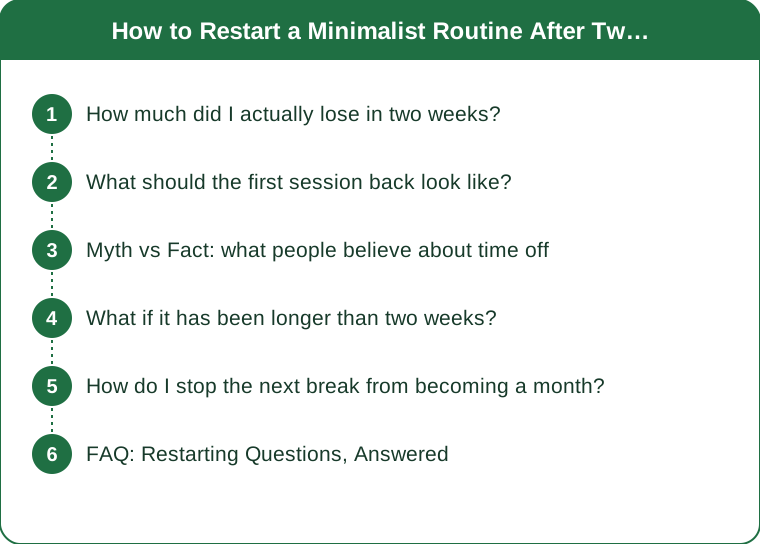
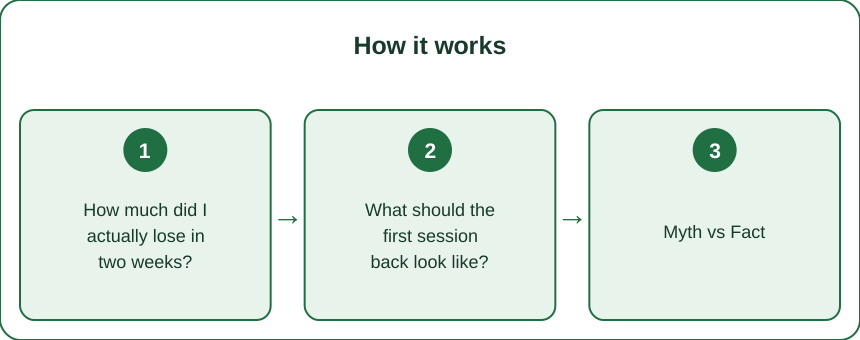
How much did I actually lose in two weeks?
Less than the internal narrative suggests, and the losses are uneven.
Strength: minimal. Studies on short-term detraining generally show maximal strength well preserved over 2-3 weeks. What you lose first is neural efficiency - coordination and confidence under load - which comes back within one to two sessions.
Muscle size: essentially none at two weeks. Visible change requires considerably longer.
Cardiovascular fitness: this one is real. Measurable declines in VO2 max appear within about two weeks, with blood plasma volume dropping earlier. Expect the first run or cycle back to feel genuinely harder. That is the honest one.
Work capacity and tolerance for volume: reduced. This is why the first session back produces disproportionate soreness even at moderate weight.
What is actually lost: the habit. Two weeks is long enough to break a routine’s automaticity, and that is the thing that takes real effort to rebuild - not the fitness.
What should the first session back look like?
Deliberately underwhelming. That is the whole strategy.
The 80% rule: take the last weight or intensity you used and drop it by about 20%. Keep the same exercises, keep the same sets and reps. Finish feeling like you could have done more.
Cap the session at 20-30 minutes. Rebuilding a habit is a scheduling problem, and a short session is easy to schedule.
Skip anything new. No new movement, no new program, no new equipment. Novelty is the enemy of restarting - it adds decision load exactly when you have the least.
Do not test yourself. The urge to see ‘where I am’ is strong and it reliably produces a session that hurts for four days.
Minimalist routines have a real advantage here: with two or three movements, there is no program to relearn. You do the same thing you always did, slightly lighter. Complexity is what makes restarts intimidating, and you do not have any.
Myth vs Fact: what people believe about time off
Myth: Two weeks off means starting over. Fact: strength is largely intact at two weeks. Starting over is what people do, not what their body requires - and it is the source of most restart injuries.
Myth: You should train harder to make up for lost time. Fact: the accumulated deficit is small; the injury risk from a compensatory hard session is not. There is nothing to make up.
Myth: Muscle turns to fat during time off. Fact: different tissues, no conversion possible. Two weeks changes body composition negligibly in either direction.
Myth: Soreness after the first session back means real damage. Fact: that is standard delayed-onset muscle soreness from reintroducing an unfamiliar stimulus. It is normal and it is also mostly avoidable by using the 80% rule.
Myth: If you keep missing, you lack discipline. Fact: most restart failures are scheduling failures. The people who come back consistently are the ones who scheduled a 20-minute session, not the ones with more willpower.

What if it has been longer than two weeks?
The principle holds, the numbers change.
- 3-4 weeks: start at 70% of previous load, rebuild over three or four sessions. Cardio will feel noticeably harder; that is expected and it returns fast.
- 1-2 months: start at 60%, and give it two to three weeks to return to previous loads. Real strength decline begins showing in this window.
- 3+ months: treat it as a fresh start on load, but not on skill. Movement patterns are retained remarkably well - the technique is still there even when the capacity is not.
Muscle memory is a real phenomenon, not a gym myth. Previously trained muscle regains size and strength faster than it was built the first time, and the effect appears to persist for a long time.
So the longer the break, the more patient the on-ramp - and the more confident you can be that it comes back faster than it went.
How do I stop the next break from becoming a month?
Build the minimum version now, before you need it.
Define your floor session in advance. For a minimalist routine that might be: 10 squats, 10 push-ups, a 30-second plank, three rounds. Eight minutes, no equipment, works in a hotel room. Write it down and keep it in your phone’s notes.
Use it during the disruption, not after. The purpose is not physiological maintenance - eight minutes does not maintain much. The purpose is keeping the habit alive, which is the thing that actually broke.
Attach it to something fixed. Right after the morning coffee, right before the shower. A routine attached to a time gets skipped; one attached to an existing behavior survives travel.
Plan the return date before the break starts. ‘Back on Monday’ beats ‘back when things calm down’ by an enormous margin, and September - with the schedule tightening back up after summer - is the easiest re-entry point of the year.
Minimalism is not just an efficient training philosophy. It is the most restart-resistant one, because the floor is low enough to step onto from anywhere.
FAQ: Restarting Questions, Answered
Should I do more cardio to make up for the cardio loss?
No - just resume normally. Cardiovascular fitness rebuilds quickly, typically within one to two weeks of consistent training, and the perceived difficulty drops well before the numbers do.
Will I be sore no matter what?
Some soreness is likely on any return. The 80% rule keeps it in the annoying range rather than the cannot-sit-down range. If you are still sore on day four, you started too heavy.
Is it worth doing something on days I only have ten minutes?
Yes, disproportionately. Not because ten minutes maintains fitness, but because it maintains identity and habit - and those are what determine whether the two-week break becomes a two-month one.
TL;DR:
- Two weeks off costs little strength, some cardio, and mostly the habit itself.
- Restart at 80% of previous load, same movements, 20-30 minutes, no testing yourself.
- Longer breaks: 70% at a month, 60% at two - and muscle memory makes the return faster than the build was.
- Soreness on day four means you started too heavy, not that you lost more than you thought.
- Write down an eight-minute floor session now and use it during disruptions, not after.
The fitness comes back on its own schedule. The habit only comes back if you deliberately make the first session too easy to dread.
Keep Reading
This article is for general informational and styling purposes only. Fit, sizing, and product availability may vary.