Minimalist Training Fails When You Cut the Wrong Thing
Quick Answer: Strength holds up remarkably well on reduced volume, but it depends on frequency staying intact. Two brief sessions a week retain most strength gains; one long session a week does not. When you go minimal, cut sets and exercises, not training days.
You trimmed the program to the essentials and progress stalled anyway. The usual conclusion is that minimalism does not work. The more likely explanation is that you cut the one variable that was holding the whole thing together.

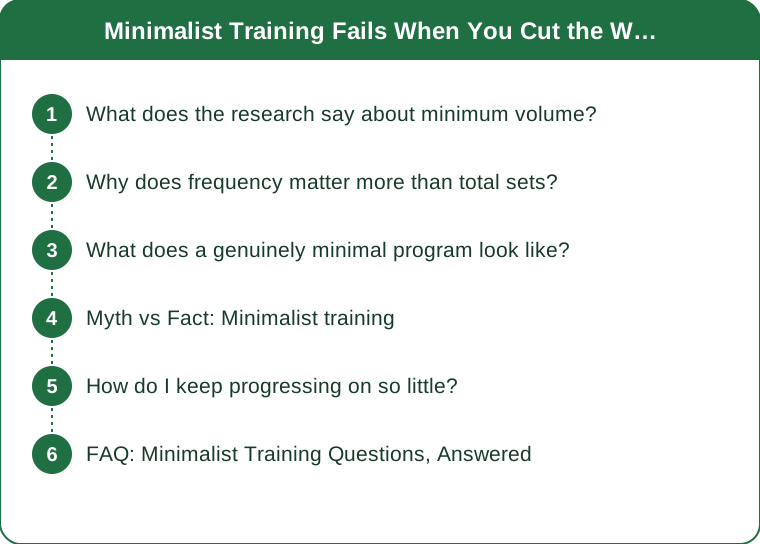
What does the research say about minimum volume?
Maintenance and growth are different questions with different answers.
For maintaining strength, studies on detraining and reduced-volume training consistently show that as little as one-third of prior volume preserves strength for months, provided frequency stays at two-plus sessions per week.
For building, the picture shifts. Growth responds to weekly sets per muscle, with meaningful returns from roughly 4 up through 12-20 sets depending on the person. But those sets work better spread across two or three sessions than crammed into one.
The practical read: 2 sessions a week is the floor for keeping what you have. Below that, decline starts within about three weeks.
Why does frequency matter more than total sets?
Muscle protein synthesis rises after training and returns to baseline within roughly 48 hours for trained lifters. Training a muscle once a week leaves four or five days where nothing is elevated.
Splitting the same total work across two days keeps that signal up twice as often. Same sets, same time, better distribution.
There is also a quality argument. Set nine of a marathon session is worse than set three of a shorter one. Fatigue degrades bar speed and technique, and the last sets of a long session contribute less than their count suggests.
What does a genuinely minimal program look like?
Two sessions per week, 25-35 minutes each, four movements per session:
Day A: goblet or back squat 3x6, push-up or press 3x8, row 3x10, carry 2x40 steps
Day B: hinge or Romanian deadlift 3x6, incline press 3x8, pulldown or pull-up 3x6, split squat 2x8 per side
Rest 90 seconds between sets. Add weight when the top set feels like two reps are left in the tank.
That is 11 working sets per session, 22 per week, hitting everything twice. It is unglamorous and it holds strength indefinitely for most people while building slowly.

Myth vs Fact: Minimalist training
Myth: Minimal means low effort. Fact: reduced volume only works when proximity to failure goes up. Two sets taken close to failure beat five easy ones, and this is the trade minimalism actually asks for.
Myth: You need to hit each muscle from multiple angles. Fact: for maintenance and general strength, one good compound per pattern covers it. Angle variety matters more for advanced hypertrophy goals than for the person trying to fit training into a full week.
Myth: Cardio and lifting cannot share a minimal program. Fact: they interfere less than people fear at low volumes. The interference effect shows up mainly at high concurrent volumes.
Myth: Skipping a week undoes everything. Fact: strength is durable. One missed week costs almost nothing; the problem is when one becomes six.
How do I keep progressing on so little?
Progression has to come from somewhere, and on low volume it comes from load and effort rather than accumulation.
- Add weight or a rep to one lift per session, not all of them
- Keep the last set of each exercise within 1-3 reps of failure
- Log every session, because minimal programs punish drift and you cannot eyeball it
- Deload by cutting sets, not days, every fifth or sixth week
Also resist the pull to add exercises when progress feels slow. Adding volume to a minimal program is how it stops being minimal and starts being a program you abandon in November.
FAQ: Minimalist Training Questions, Answered
Can I do three short sessions instead of two?
Yes, and it is slightly better if the time exists. Three 20-minute sessions beat two 30-minute ones for most goals.
Is bodyweight enough?
For a while. Once you can do 15 clean reps of a movement, progression requires either load, harder variations, or much higher volume. A single adjustable kettlebell solves this cheaply.
What if I miss a session?
Do it the next available day and shift the week. Do not double up; a combined session is longer, worse, and more likely to be skipped entirely.
TL;DR:
- Two sessions per week is the floor for maintaining strength; one is not enough
- Cut sets and exercises when going minimal, never training days
- Low volume only works when the last set is genuinely close to failure
- Progress by adding load to one lift per session, not by adding exercises
If your minimal program stalled, count your training days before you count anything else. Moving from one long session to two shorter ones changes nothing about your weekly time and usually restarts progress within a month.
Keep Reading
This article is for general informational and styling purposes only. Fit, sizing, and product availability may vary.