The One-Kettlebell Program: Complete Fitness From a Single Piece of Iron
The minimalist fitness question — what’s the least equipment for complete training — has a strong one-word answer: kettlebell. One bell covers strength, conditioning, power and carries in two square meters. The one-bell program: the case, the five moves and the year of progression.
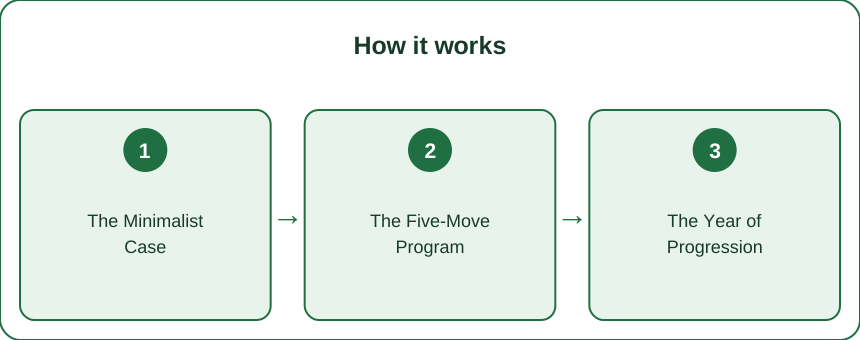
The Minimalist Case
Why one bell suffices: the movement coverage (the swing for power-and-conditioning, the goblet squat for legs, the press for pushing, the row for pulling, the carry for core-and-grip — the five patterns from the pattern doctrine in one handle), the two-square-meter truth (the training footprint from the minimal-fitness doctrine — the apartment-corner gym; the bell under the bed between sessions), the cost math (the one-time fifty-dollar purchase versus the membership year — the budget doctrine’s cleanest win), the decision-elimination bonus (the one-tool program deleting the what-should-I-do question — the constraint as feature per the minimalist doctrine; the bell that makes the workout obvious), and the honest limits (the max-strength ceiling and the barbell tier existing for those goals — the one-bell program as complete GENERAL fitness, which is what most people actually want per the two-day doctrine).
The Five-Move Program
The whole system: the swing (the hip-hinge power move — the form keys from the kettlebell chapters: hips back, arms as ropes, snap; the conditioning engine of the program), the goblet squat (the bell hugged at the chest — the squat pattern with built-in counterbalance; the depth-friendly version from the beginner doctrine), the single-arm press (the overhead push with the offset-load core bonus — the strict form floor; the both-sides rule), the single-arm row (the hinge-and-pull that balances the press — the two-to-one pull emphasis from the posture doctrine honored across the week), the carry suite (the farmer, rack and overhead carries — the walking core-and-grip work from the carry doctrine; the program’s underrated fifth pillar), and the session shapes (session A: swings and squats and carries; session B: presses, rows and swings — the two-day alternation from the minimal doctrine; the 25-minute honest clock).

The Year of Progression
One bell, twelve months: the phase-one skill quarter (the movements owned at crisp quality — the technique-first doctrine; the reps grown from 3x8 toward 3x15), the phase-two density quarter (the same work in less time — the rests trimmed, the circuits formed; the conditioning arriving inside the strength), the phase-three complex quarter (the moves chained — the swing-to-squat-to-press flows; the complexes that make one bell feel like a gym; the EMOM formats from the kettlebell-cardio doctrine), the phase-four asymmetry quarter (the single-arm and offset work deepened — the anti-rotation core tier; the pistol-squat and windmill explorations for the ambitious), the bell-size decision point (the second bell bought when the first is honestly easy — the size-up rules from the progression doctrine; the two-bell world as year-two territory, optional), and the deload rhythm (the every-fourth-week easy block per the recovery doctrine — the year that compounds because it pauses).
The Life Fit
The program in practice: the schedule reality (the two-to-three weekly sessions plus daily walks being the complete week — the minimal-fitness thesis proven in iron), the travel note (the bell that doesn’t travel replaced by the band-and-bodyweight versions on the road — the movement patterns portable even when iron isn’t per the travel doctrine), the household sharing (the one bell serving two people at different rep ranges — the family gym at fifty dollars), the boredom insurance (the four phases and the complex library keeping one tool interesting — the variety-within-constraint craft), the maintenance legitimacy (the year-two option of simply continuing — the program maintained being a complete fitness life per the maintenance doctrine; the forever-program candidate), and the invitation close (the bell bought this week, the swing learned properly first — the one purchase that ends the equipment excuse permanently; the gym, reduced to a handle and your attention). Five moves, two sessions, one bell: the everything, minimized.
One kettlebell covers all five patterns — swing, goblet squat, press, row, carry — in two 25-minute weekly sessions. Progress reps, then density, then complexes, then asymmetry: a full year from fifty dollars of iron.
Keep Reading
This article is for general informational and styling purposes only. Fit, sizing, and product availability may vary.