How to Know When Your Minimalist Routine Actually Needs One More Exercise
Quick Answer: A minimalist routine typically needs one more exercise added when a specific muscle group or movement pattern has gone unaddressed for several weeks and starts showing up as a real weakness, a nagging ache, or a stalled overall progress — not simply because more exercises feel more thorough.
The appeal of a minimalist routine is doing less while still progressing. The risk is not noticing when ‘less’ has quietly become ‘not quite enough’ for one specific area.

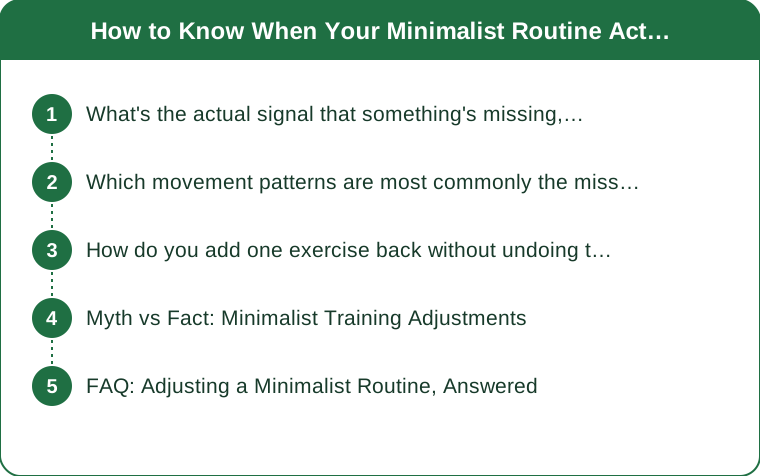
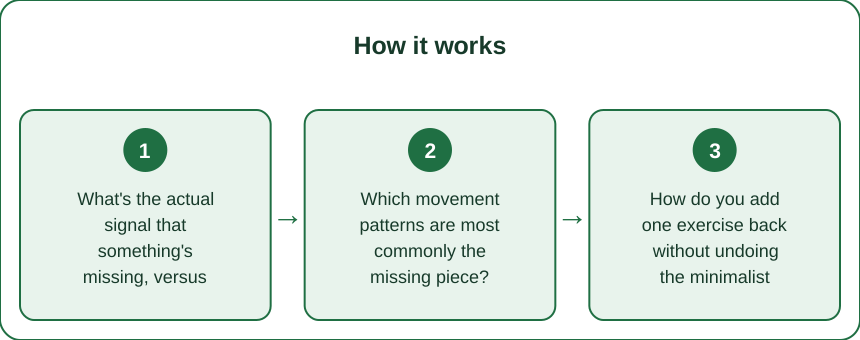
What’s the actual signal that something’s missing, versus normal minimalist discipline?
The clearest signal is a specific, localized issue — a persistent ache in one joint, a movement that feels disproportionately weak compared to everything else, or a plateau that’s isolated to one lift while others keep progressing. This is different from general fatigue or a normal strength plateau, which minimalist routines handle fine through progressive overload alone.
A useful gut-check: if the issue is broad and routine-wide, the fix is usually adjusting volume or intensity within the existing exercises. If the issue is narrow and specific to one pattern the routine doesn’t touch at all, that’s the signal an addition is actually needed.
Which movement patterns are most commonly the missing piece?
Direct hip hinge work, unilateral (single-leg or single-arm) movements, and horizontal pulling are the three patterns most often left out of a stripped-down routine built around a handful of compound lifts like squats and presses. A routine heavy on bilateral, symmetric lifts can quietly build an imbalance that doesn’t show up until months in, often as a nagging asymmetry or a specific weak link during a heavier lift.

How do you add one exercise back without undoing the minimalist approach?
The goal is a single, well-chosen addition, not a slow creep back to a ten-exercise routine. Pick the one movement that most directly addresses the identified gap, and give it the same 2-3 sets, 2x-per-week treatment as the rest of the routine, rather than layering on extra volume everywhere. This keeps the philosophy — fewer, well-chosen movements — intact while closing the specific gap.
Myth vs Fact: Minimalist Training Adjustments
Myth: Needing to add an exercise means the minimalist approach failed. Fact: A single, targeted addition based on a real signal is consistent with minimalism’s core idea — doing only what’s necessary — it’s not a philosophical failure, it’s the routine responding to real data.
Myth: More exercises always means better balance and fewer imbalances. Fact: A poorly chosen tenth exercise doesn’t fix an imbalance any better than the right single addition — quantity isn’t the lever, targeting the actual gap is.
FAQ: Adjusting a Minimalist Routine, Answered
How long should I wait before deciding a signal is real and not just temporary soreness?
A genuinely persistent issue — an ache or weakness showing up consistently across 3-4 weeks rather than one or two rough sessions — is a more reliable signal than a single bad week, which could just be normal fatigue.
Should I remove an existing exercise to make room for the new one?
Not necessarily — if the routine is still genuinely minimal (2-4 total movements per session), adding one more without removing anything usually keeps total volume reasonable; removing something only becomes necessary if total session time or fatigue starts creeping up.
Is it normal for a minimalist routine to need this kind of adjustment more than once?
Yes — as strength and movement patterns change over months, different gaps can emerge at different points, and periodically reassessing (roughly every few months) is a normal part of keeping a minimal routine actually complete rather than static.
TL;DR:
- A specific, localized ache or weakness is the real signal — not general fatigue
- Hip hinge, unilateral, and horizontal pulling patterns are the most commonly missing pieces
- Add exactly one targeted exercise at the same volume as the rest, not a full routine expansion
- Reassess every few months, since different gaps can emerge as strength changes
Adding the right single exercise keeps the minimalist philosophy intact — it’s not a step backward, it’s the routine doing what it’s supposed to do.
Keep Reading
This article is for general informational and styling purposes only. Fit, sizing, and product availability may vary.