Where Cardio Fits in a Minimalist Strength Routine
Quick Answer: In a minimalist strength routine, cardio should be treated as a separate small dose rather than an add-on to lifting days: two 20 to 30 minute sessions of easy-effort work per week, ideally on non-lifting days or at least six hours away from lifting. Keeping the intensity genuinely low protects strength progress, while high-intensity intervals stacked next to lifting are where the interference effect actually shows up.
Minimalist training solves the time problem for strength and then leaves a gap. You are lifting twice a week for 35 minutes, you feel good, and you also know your cardiovascular fitness is not being trained. The answer is not adding a third and fourth workout — it is placing a small amount of cardio where it costs you nothing.

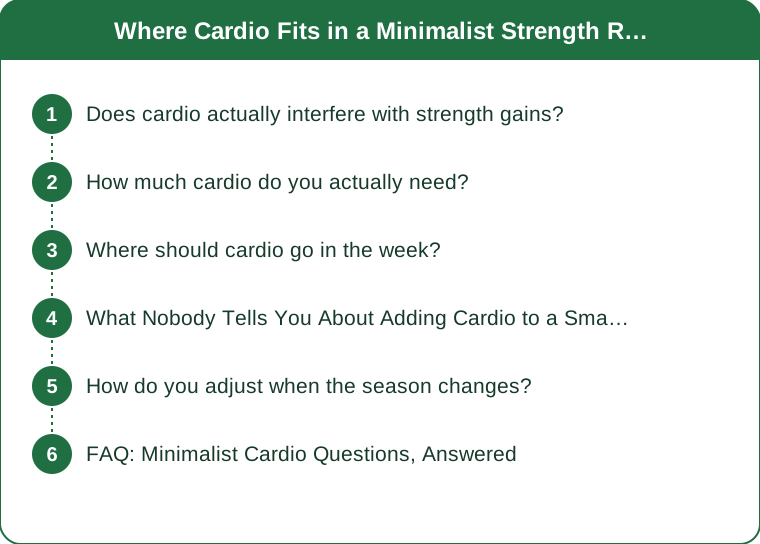
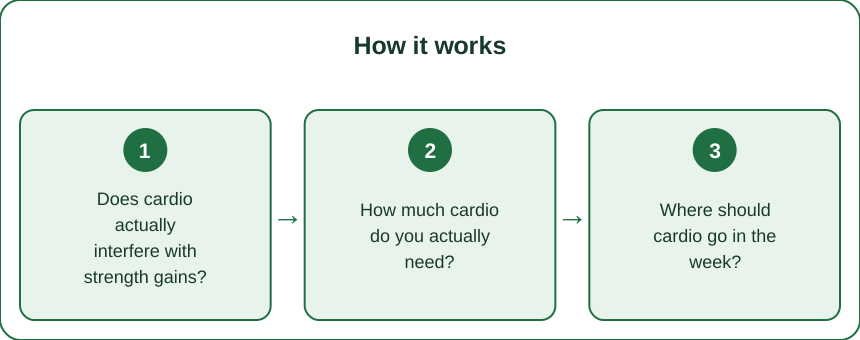
Does cardio actually interfere with strength gains?
Less than the internet suggests, and the details determine everything.
The interference effect is real but modest, and it scales with three variables: volume, intensity, and proximity to lifting. Research on concurrent training consistently finds that low-volume, low-intensity cardio done separately from lifting has minimal effect on strength or hypertrophy. High-volume running done immediately before or after a lifting session has a measurable one.
The mechanism is partly fatigue and partly muscle group overlap. Cycling and running load the legs directly, so leg strength is where interference appears first. Upper body strength is barely affected by any amount of cardio.
For a minimalist trainee this is mostly good news. You do not have enough lifting volume for interference to be your limiting factor. Someone training four lifts twice a week has far more recovery headroom than someone running a six-day program, which means cardio fits more easily, not less.
The person who should worry about interference is the advanced lifter chasing a one-rep max. If that is not you, place the cardio sensibly and stop thinking about it.
How much cardio do you actually need?
The public health floor is 150 minutes of moderate activity per week, and most of that can come from walking.
For cardiovascular health specifically, two structured sessions of 20 to 30 minutes plus daily walking covers the great majority of the benefit. The gap between zero structured cardio and two sessions per week is enormous; the gap between two and five is comparatively small.
A reasonable minimalist prescription:
- Two sessions of 20 to 30 minutes at conversational effort — you can speak in full sentences.
- One of those can be replaced with a brisk 45-minute walk if you prefer.
- Daily movement of 6,000 to 8,000 steps as the background, not as one of the two sessions.
That is roughly 60 minutes of dedicated cardio per week, on top of maybe 70 minutes of lifting. Total training commitment stays under two and a half hours, which is still genuinely minimalist.
If you have a specific endurance goal — a 10K, a hiking trip — that changes the calculation and you should expect strength progress to slow while you train for it. That trade is fine as long as it is deliberate.
Where should cardio go in the week?
In order of preference:
Best: separate days. Lift Monday and Thursday, cardio Tuesday and Saturday. No interference, full recovery for both, and the week has a natural rhythm.
Good: same day, six or more hours apart. Lift in the morning, easy cardio in the evening. This works well for people who prefer training days clustered so other days stay free.
Acceptable: after lifting, same session. If you must combine, cardio goes after the lifting, never before. Ten to fifteen minutes of easy work as a cooldown costs you almost nothing.
Avoid: hard intervals before lifting, or a long run the day before a lower body session. Both blunt the quality of the lifting session, which is the part of your program with the least room to spare.
One practical note for minimalist trainees specifically: if adding cardio means you start skipping lifting sessions, cut the cardio. The two lifts a week are the non-negotiable core, and everything else is built around protecting them.

What Nobody Tells You About Adding Cardio to a Small Program
The recovery cost is not where you expect it.
Most people assume the issue is muscular fatigue. In practice, for a minimalist program, the limiting factor is usually total weekly time and mental bandwidth — and adding two more calendar commitments is exactly how a sustainable two-day program becomes an abandoned four-day one. The failure mode is adherence, not physiology.
Second thing: easy cardio genuinely helps recovery rather than hurting it. Low-intensity work increases blood flow and often reduces soreness from the previous lifting session. Many people find their squat day feels better when there was an easy 25-minute session two days before.
Third: the intensity creep is almost inevitable. Easy sessions become moderate sessions, moderate becomes hard, and within a month you are doing two hard workouts that fight your lifting. Use a heart rate cap or the talk test, and accept that the sessions should feel almost too easy.
And fourth — walking counts more than people believe. A daily 30-minute walk delivers a substantial portion of cardiovascular benefit at effectively zero recovery cost. If you are choosing between adding two runs or adding a daily walk, the walk is the better first move for most minimalist trainees.
How do you adjust when the season changes?
Right now is the easiest cardio window of the year, and it does not last.
Early mornings are cool, evenings still have light, and outdoor sessions require no planning. This is the moment to establish the habit, because starting a new outdoor cardio routine in November is a considerably harder sell.
Build in the indoor fallback now, before you need it. Know exactly what your session becomes when it is dark and raining — a stationary bike, a rowing machine, a 20-minute circuit at home. The people who keep cardio through winter are the ones who decided the alternative in September, not the ones improvising in December.
Schedule shifts matter too. As daylight shortens, evening sessions get squeezed and the natural move is to the morning, which usually means the cardio session lands closer to the lifting session. Plan the week so that shift does not accidentally stack a hard run the morning after a lower body day.
And expect a temporary drop when the clocks change. A week or two of reduced volume around a seasonal transition is normal and not worth restructuring the program over.
FAQ: Minimalist Cardio Questions, Answered
Does HIIT count if I only have ten minutes?
Yes, and it is a legitimate use of limited time — but limit it to one session per week alongside a minimalist lifting program. High-intensity work carries a real recovery cost, and two hard interval sessions plus two lifting sessions is no longer minimalist.
Can I skip cardio entirely if I lift?
You can build a great deal of health from lifting alone, but resistance training does not fully replace cardiovascular conditioning. Even a daily brisk walk closes most of that gap without adding a workout to your calendar.
Will cardio make me lose muscle?
Not at the volumes described here. Muscle loss from cardio requires high volume combined with inadequate protein and a significant calorie deficit. Two easy 25-minute sessions per week with adequate protein has no meaningful effect.
TL;DR:
- Interference is real but modest, and mostly affects legs at high cardio volumes done close to lifting.
- Two easy 20 to 30 minute sessions per week plus daily walking captures most of the cardiovascular benefit.
- Put cardio on non-lifting days if possible; if combining, do it after lifting, never before.
- Protect the two lifting sessions above all — if cardio starts crowding them out, cut the cardio.
Add one easy session this week and see how the next lifting day feels. Most people find it helps, and the ones who do not usually discover their easy session was not actually easy.
Keep Reading
This article is for general informational and styling purposes only. Fit, sizing, and product availability may vary.