Why a Minimalist Routine Breaks the Moment Your Schedule Changes Season
Quick Answer: Minimalist routines break in a seasonal transition because they are anchored to a time slot rather than a trigger, and the slot is usually the one daylight takes away first. A three-exercise session is easy to perform and easy to skip, because nothing depends on it. The fix is to re-anchor the session to a fixed daily event, cut it to a floor you can hit on the worst day, and accept a lower frequency deliberately rather than by accident.
The routine was perfect all summer. Three lifts, twenty minutes, four days a week, no fuss.
Then the evenings got dark, work got busy, and you have done it twice in three weeks.
This is a specific failure mode with a specific cause, and it is not motivation.

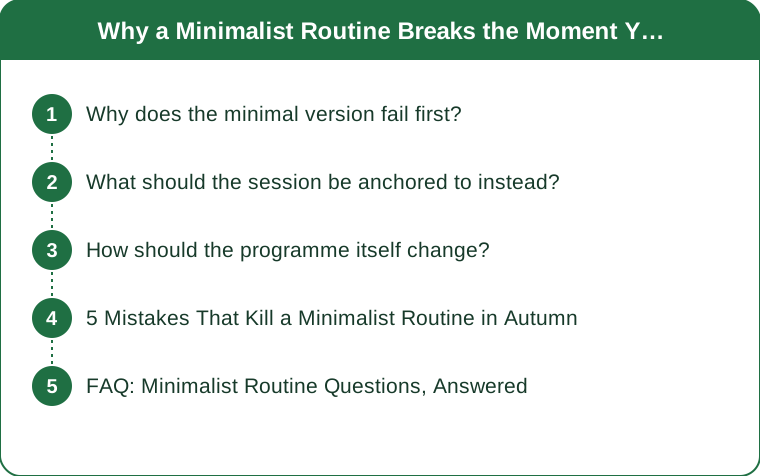
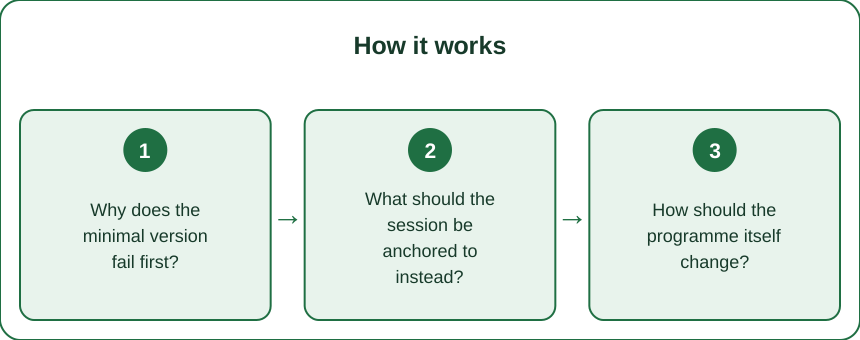
Why does the minimal version fail first?
Because everything that makes it minimal also makes it easy to drop.
A short session has low friction to start and low friction to skip. A 90 minute gym trip has a commute, a bag and a plan — sunk costs that carry you through ambivalence. A twenty minute session at home has none, so a mild disinclination is enough to end it.
It is anchored to a time, not to an event. Most minimalist routines run at a slot — after work, before dinner. When the season shifts the shape of the day, the slot moves and nothing catches the session.
There is no external accountability. No class, no training partner, no booking. The routine’s efficiency comes precisely from removing all of that.
The progress signal is slow and quiet. Two or three exercises produce real progress, but slowly enough that a two-week gap does not produce an obvious consequence. Nothing punishes the skip.
Daylight was doing more work than you realised. For many people the trigger was arriving home in the light, or being outdoors already. That environmental cue disappears within a few weeks in September, and the routine loses its actual anchor.
And the buffer was already zero. A minimalist routine has no redundancy by design. In a five-day-a-week programme, missing one day is 20 percent. In a two-day programme, missing one is 50 percent.
What should the session be anchored to instead?
A fixed daily event that the season cannot move.
Anchor to waking, not to a clock time. Within 30 minutes of getting up is the most robust anchor available, because wake time is the last thing to drift and the first thing worth stabilising anyway.
Or anchor to an unavoidable transition. Immediately after the school drop-off, straight after the last work call, before the shower you take every day regardless. The requirement is that the anchoring event happens whether or not you feel like training.
Put the equipment where the anchor is. A kettlebell in the hallway you walk down at 7am beats a fully equipped garage you have to decide to visit. Physical proximity to the cue matters more than equipment quality.
Write the session down as a fixed sequence. Deciding what to do is a decision point, and decision points are where seasonal routines die. The session should be identical every time so that starting requires no thinking at all.
Use a two-tier structure: full session and floor session. The floor is what you do on the worst possible day — one set of three exercises, six minutes. Never skip entirely; drop to the floor. The habit survives, and the habit is the asset.
Consider moving to mornings for the season specifically. This is not a personality question. Evening anchors are the ones daylight destroys, and a seasonal shift to mornings is a reasonable four-month adjustment rather than a permanent identity change.

How should the programme itself change?
Reduce frequency deliberately and protect intensity, rather than letting both erode.
Choose two sessions a week and defend them absolutely. Two sessions performed for six months beats four sessions performed for three weeks. Deciding on two is a strategy; drifting to two is a collapse.
Keep the compound lifts, cut the accessories. A squat or hinge, a push, a pull. That is the irreducible core and it maintains almost everything over a maintenance period.
Maintain load, reduce volume. Research on training reductions consistently shows that intensity is what preserves strength. Cutting from four sets to two while keeping the weight maintains far more than the reverse.
Two hard sets to near failure is a legitimate session. For maintenance, a small number of quality sets does most of the work. Ten minutes done properly is not a compromise.
Add a deload deliberately in the transition week. The week routines usually break is a good week to plan a lighter one, so the reduction is a decision rather than a failure.
Track only attendance for eight weeks. During a disrupted period, whether you showed up is the metric that matters. Load progression can resume when the schedule stabilises.
Seasonal note: the specific week that breaks most routines is the one where evening light drops below the point where outdoor sessions work. In most mid-latitude regions that falls in the second half of September. Move the anchor before that week, not after — repairing a lapsed routine costs far more than pre-empting it.
5 Mistakes That Kill a Minimalist Routine in Autumn
Keeping the summer time slot out of loyalty. The slot worked because of conditions that no longer exist. Change it early and deliberately.
Trying to add volume to compensate for missed sessions. Doubling up after a skip makes the next session worse and the one after that less likely. Just resume the standard session.
Treating a floor session as a failure. Six minutes counts. The routine’s entire value is continuity, and a floor session preserves it perfectly.
Waiting for motivation to return in October. It does not return on its own; the anchor returns it. Fix the anchor and the motivation follows.
Changing the programme when the problem is the schedule. People respond to a lapse by redesigning the routine, which adds decisions and makes restart harder. The exercises were fine. The trigger was the problem.
And the sixth, which is the common one: dropping from four days to zero rather than to two. The failure is almost never gradual — it is a cliff. Choosing the reduced version in advance is what prevents the cliff.
FAQ: Minimalist Routine Questions, Answered
How little can I do and still maintain strength?
Research on reduced training suggests strength is well maintained on markedly reduced volume provided intensity stays high — for many people, two sessions a week with hard sets is sufficient for maintenance.
Should I switch to morning workouts for the winter?
If your anchor was an evening condition that daylight removed, yes. It is a seasonal adjustment, not a permanent one.
What is a reasonable floor session?
One set each of a squat or hinge, a push and a pull, taken close to failure. Six to eight minutes. Do it on the days you would otherwise skip.
Will I lose progress on two sessions a week?
You will likely maintain and may still progress slowly. You will certainly do better than on four sessions that stop in October.
How long until a lapsed routine is hard to restart?
Most people find restarting harder after two to three weeks, largely because the cue association weakens. Dropping to a floor session prevents this entirely.
Should I train at home or keep the gym?
Whichever has the more reliable anchor for this season. A home session you actually do beats a gym session you plan to.
TL;DR:
- Minimalist routines break because they are anchored to a time slot that the season removes.
- Re-anchor to a fixed daily event — within 30 minutes of waking is the most robust.
- Keep a two-tier structure: full session, and a six-minute floor session for the worst days.
- Choose two sessions a week deliberately and hold intensity; volume is what you cut.
- Move the anchor before the mid-September light drop, not after the routine lapses.
The exercises were never the problem. Fix the trigger.
Keep Reading
This article is for general informational and styling purposes only. Fit, sizing, and product availability may vary.