Why a Minimalist Routine Can Stall Progress Without Adding a Single New Exercise
Quick Answer: A minimalist routine most often stalls not because it needs more exercises, but because the same weight, reps, and tempo have been repeated too long without progressive overload — increasing load, slowing tempo, or adding a pause at the hardest point of each lift restarts progress within the exact same small set of movements, which keeps the routine’s minimalist philosophy intact while still forcing adaptation.
The instinct when a minimalist routine plateaus is to add more exercises, but that usually solves the wrong problem — the routine doesn’t need more movements, it needs the existing ones to actually get harder.

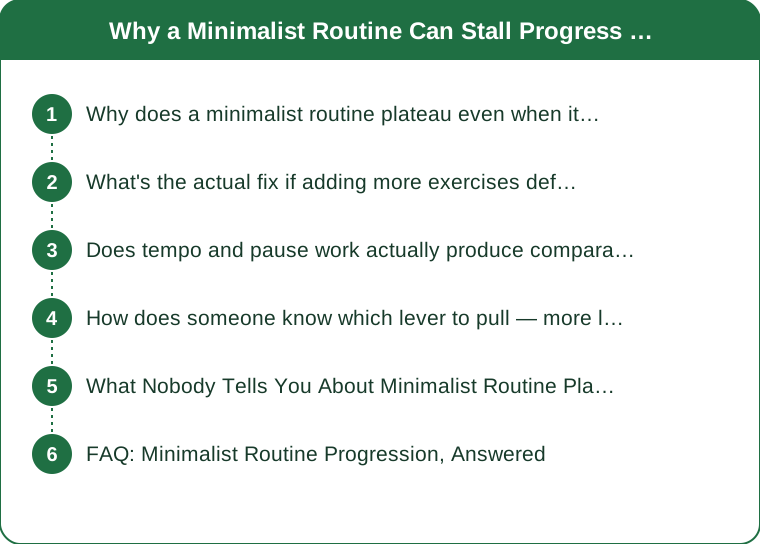
Why does a minimalist routine plateau even when it was working well before?
Progress requires progressive overload — a gradually increasing demand on the muscle over time — and a minimalist routine’s small exercise list makes it especially easy to unconsciously plateau at the same weight and rep count for weeks without noticing, since there’s no variety masking the lack of progression. The fewer exercises a routine has, the more critical it becomes to deliberately track and increase difficulty within each one.
What’s the actual fix if adding more exercises defeats the point of going minimalist?
Increasing load first, even by small increments, is the most direct fix and the one most aligned with minimalist training philosophy — a 5% weight increase every one to two weeks, tracked deliberately rather than left to feel, restarts progress without touching the exercise list at all. When load increases become impractical (bodyweight-only routines, for example), slowing the tempo or adding a pause at the hardest point of the movement creates a comparable difficulty increase using the exact same exercise.
Does tempo and pause work actually produce comparable results to adding weight?
Research on time-under-tension suggests that slower eccentric (lowering) phases and paused positions at peak difficulty meaningfully increase the muscular demand of a given exercise, even without any change in load. A push-up done with a 3-second lowering phase and a 1-second pause at the bottom is a genuinely harder version of the same movement, using zero additional exercises or equipment.

How does someone know which lever to pull — more load, or tempo change — for their specific routine?
For loaded exercises (dumbbells, kettlebells, a barbell), increasing load is usually the simplest and most trackable lever. For bodyweight-dependent movements where load can’t easily increase, tempo, pause, and single-limb variations of the same movement pattern (a single-leg version of a squat, for instance) provide the progression a minimalist routine needs without expanding the exercise list.
What Nobody Tells You About Minimalist Routine Plateaus
A minimalist routine plateau is very often a tracking problem disguised as a programming problem — without a log of weight, reps, and tempo, it’s easy to repeat the exact same session for months while believing it’s still progressing. Simply starting to log these details, even loosely, often reveals the plateau’s real cause before any actual program change is needed.
FAQ: Minimalist Routine Progression, Answered
How often should load or difficulty actually increase in a minimalist routine?
A small increase every one to two weeks is a reasonable general pace for most lifters, adjusted based on whether the previous session’s reps were completed with good form and some effort in reserve.
Is it ever actually necessary to add an exercise to a minimalist routine?
Occasionally, if a specific movement pattern (like hip hinging, or overhead pressing) is entirely missing from the current lineup, but this is a gap-filling addition, not a response to a plateau in an already well-rounded minimalist routine.
Does a minimalist routine eventually run out of room to progress with the same exercises?
Eventually additional strategies like unilateral variations, tempo changes, or paused reps extend a minimalist exercise’s useful lifespan considerably before a genuinely new movement becomes necessary.
TL;DR:
- Minimalist routine plateaus are usually a progressive overload problem, not a missing-exercise problem
- Increasing load is the simplest fix for loaded exercises; tempo and pause work for bodyweight movements
- Tracking weight, reps, and tempo reveals whether a routine has quietly stopped progressing
- Adding exercises should fill a genuine movement-pattern gap, not just respond to a plateau
A stalled minimalist routine rarely needs to grow — it needs the handful of exercises it already has to keep getting harder, which is a smaller and more sustainable fix than it first appears.
Keep Reading
This article is for general informational and styling purposes only. Fit, sizing, and product availability may vary.