Why a Minimalist Routine Sometimes Stalls — and What Actually Fixes It
Quick Answer: Minimalist routines stall most often because the same weight and reps get repeated indefinitely without progressive overload — not because minimalism itself has a hard ceiling. Adding small, deliberate load or rep increases restarts progress without expanding the routine’s simplicity.
Three exercises, three times a week, and it worked beautifully for months. Then nothing changed for six weeks straight. The routine’s simplicity wasn’t the problem — its lack of progression was.

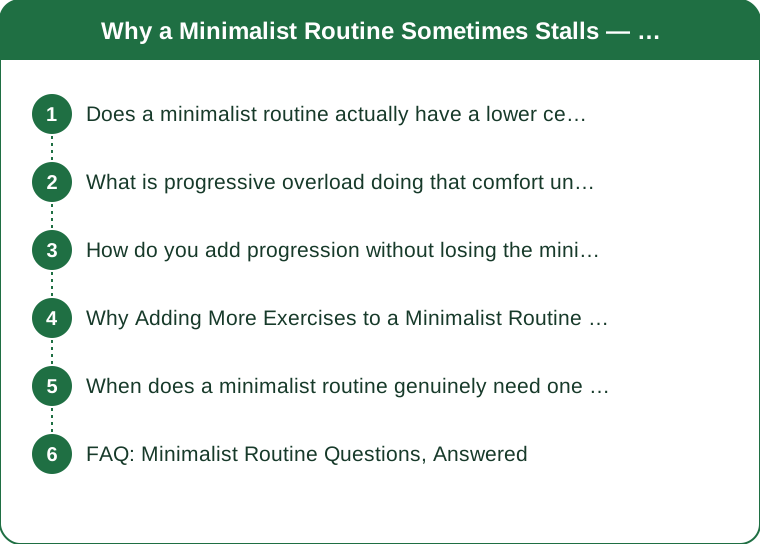
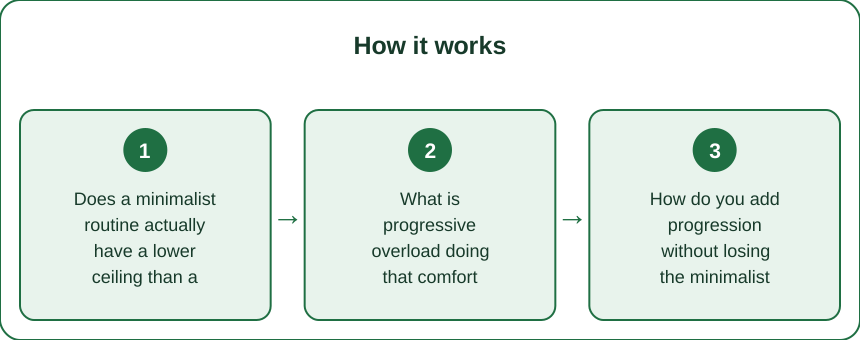
Does a minimalist routine actually have a lower ceiling than a complex one?
Not inherently — a minimalist routine still applies the same core strength-building principle (progressive overload) as any complex program. The stall usually isn’t from having fewer exercises; it’s from unconsciously keeping the same weight and reps once a routine feels comfortable and automatic.
What is progressive overload doing that comfort undoes?
Muscles and connective tissue adapt to a specific, repeated stimulus and then stop changing further under that same stimulus — this is a normal, expected biological response, not a personal failure. Without a small increase in weight, reps, or difficulty every few weeks, even a perfectly executed minimalist routine will plateau.
How do you add progression without losing the minimalist appeal?
Increase one variable at a time, on the same three exercises: add 2.5-5lbs when the current weight feels genuinely easy for all reps, or add 1-2 reps per set before adding weight. This preserves the routine’s simplicity — same exercises, same time commitment — while restarting the adaptation stimulus.

Why Adding More Exercises to a Minimalist Routine Quietly Defeats the Point
The instinct when a routine stalls is often to add exercises, but this usually just adds time and complexity without addressing the actual issue — insufficient progressive load on the exercises you already have. A minimalist routine with proper progression outperforms an expanded routine without it.
When does a minimalist routine genuinely need one more exercise?
Only when a specific movement pattern is entirely missing — for example, no pulling exercise alongside a pushing-and-squatting routine, creating a real muscular imbalance over time. That’s a legitimate gap to fill, distinct from simply wanting more variety.
FAQ: Minimalist Routine Questions, Answered
How often should I increase weight or reps in a minimalist routine?
Every 2-3 weeks is a reasonable general cadence, adjusted based on whether the current load still feels appropriately challenging by the last rep or two.
Can a minimalist routine work long-term, or does it eventually need to expand?
It can work long-term as long as progressive overload continues — the ceiling comes from stalled progression, not from having few exercises.
How many exercises does a workout actually need at minimum?
A well-chosen 3-4 exercise routine covering push, pull, and squat/hinge patterns can maintain and build strength effectively for most general fitness goals.
TL;DR:
- Minimalist routines stall from stalled progression, not from being minimal
- Progressive overload — small weight or rep increases every 2-3 weeks — restarts adaptation
- Adding exercises when progression is the real issue adds complexity without fixing anything
- Only add an exercise when a genuine movement pattern gap exists
The fix for a stalled minimalist routine is almost always more load, not more exercises.
Keep Reading
This article is for general informational and styling purposes only. Fit, sizing, and product availability may vary.